







Choosing the right Silicone Baby Bib supplier takes more than comparing prices. The bib may look simple, but its material, edges, fasteners, and pocket design affect daily use. Picture a parent wiping oatmeal from a smooth surface, then checking whether the bib still lies flat after repeated washing. Small details matter.
A note on attribution: Lin Wei is an illustrative sourcing expert, and the following line is original editorial wording, not a verified published quotation: “A reliable supplier should make quality visible, not just promise it.” That principle gives buyers a practical starting point. Ask for clear material specifications, consistent samples, and documented quality checks. Confirm how the supplier handles color differences, production changes, and defects. Details should be easy to explain.
Price still matters. But a low quote can hide thin material, weak closures, or inconsistent batches. Request samples and inspect the bib’s feel, seams, and catch pocket. Ask how orders are tracked and how concerns are resolved. Then compare suppliers using the same criteria. It takes time.
No checklist can replace careful judgment, and supplier documents do not guarantee every batch will be perfect. A better choice comes from checking evidence, asking direct questions, and noticing whether answers stay consistent. This guide explores the factors that help buyers evaluate Silicone Baby Bib suppliers with care, from product quality and communication to production capacity and long-term reliability.
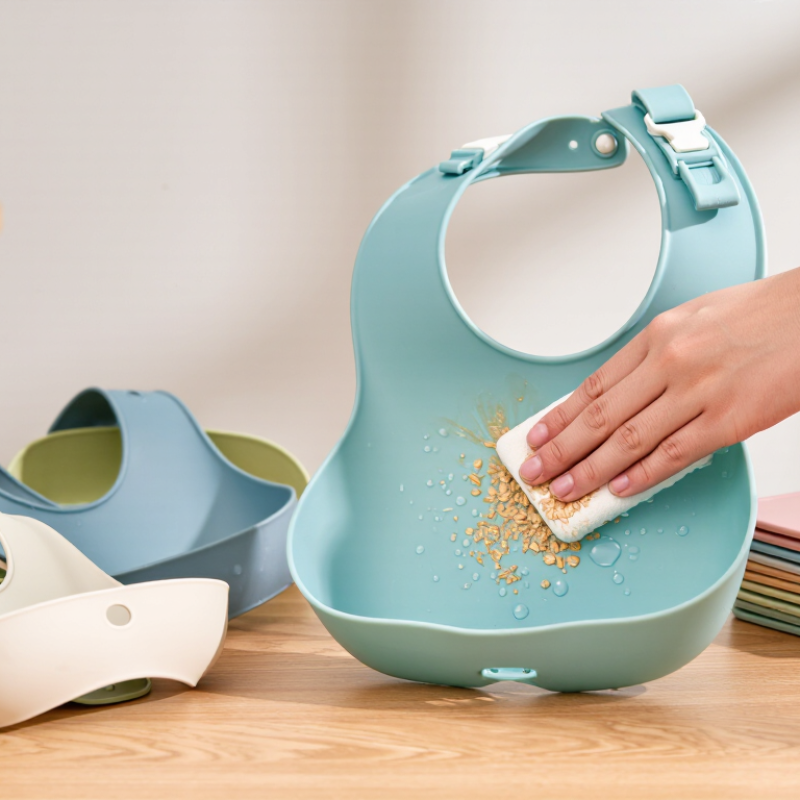
Before contacting suppliers, write down how the bib will be used. Specify its dimensions, thickness, pocket depth, closure style, colors, and expected order volume. A deep, flexible pocket may catch more food, while a softer neck opening can improve comfort. Still, softness should not make the bib lose its shape. A sample can look excellent yet feel stiff after washing, so test real use, not appearance alone.
Set compliance requirements for the markets where you plan to sell. Ask what food-contact standards apply and request relevant test reports, material specifications, and batch traceability records. Check that documents match the exact silicone formulation and color being offered. Requirements can vary by destination, so avoid relying on a general “food-grade” claim. It is easy to over-specify tests, too; confirm which evidence is actually relevant with a qualified compliance professional.
When comparing silicone quality, ask for the material specification, not just a “food-grade” claim. Request independent test reports, batch traceability, and details on odor, color stability, and tear resistance. FDA 21 CFR 177.2600 covers certain repeated-use rubber articles, but meeting a food-contact requirement alone does not prove a finished bib is safe or durable. Check what the report tested and whether it applies to the actual product. Grand View Research valued the global silicone market at about US$18.4 billion in 2023. That broad market figure signals scale, not quality. A glossy sample can still disappoint.
Design is practical engineering. Examine the neck fasteners, rounded edges, pocket opening, and how the bib sits when a baby leans forward. Ask whether the supplier can adjust mold dimensions, match colors consistently, and provide samples from production tooling. Manufacturing capability matters, too: request the production process, inspection points, defect criteria, and lead times for both samples and repeat orders. A useful supplier can explain how it checks each batch, rather than sending one polished sample and leaving questions unanswered. Compare written specifications and test records across suppliers. Small details matter. I would still inspect a fresh production sample before approving a large order; paper records cannot reveal every flaw.
| Evaluation Area | What to Check | Evidence to Request | Potential Red Flags |
|---|---|---|---|
| Silicone material | Confirm the material composition, intended food-contact use, colorants, and whether the bib contains any non-silicone parts. “Food-grade” is not a complete specification by itself. | A material specification, bill of materials, and batch-linked test documentation from a qualified laboratory. Verify that the tested sample matches the proposed production material and color. | Unclear material composition, unsupported “100% safe” claims, or reports that cannot be linked to the product or material being quoted. |
| Chemical compliance | Identify the destination market first. Applicable food-contact and children’s-product requirements depend on the market, product construction, and intended use. | Current test reports and a written compliance statement identifying the applicable requirements and the product or material tested. For the U.S., ask the supplier to explain the basis for any food-contact claim; FDA regulations do not mean that a finished bib is automatically “FDA approved.” | A generic certificate presented as universal approval, expired reports, or documents covering a different product, color, or material. |
| Odor and surface quality | Inspect samples for persistent odor, sticky or oily residue, visible contamination, uneven color, and surface defects. Assess odor after washing and drying as directed. | Production-representative samples, written inspection criteria, and retained batch samples or traceability records. | Strong persistent odor, residue that transfers to a clean cloth, or inconsistent appearance between samples and production pieces. |
| Design and fit | Check neck-opening adjustment, fastening security, bib coverage, pocket shape, edge finish, and comfort across the intended age range. Dimensions and fit should be specified in a controlled drawing. | A dimensioned drawing, target age range, tolerances, and samples tested on appropriate size references. Confirm that the pocket remains open during normal wear. | No controlled drawing, unexplained size variation, sharp or rough edges, or a pocket that collapses easily. |
| Fasteners and safety | Check that the neck fastening is secure yet usable by the caregiver, with no unintended detachable parts or accessible sharp edges. Evaluate foreseeable use and cleaning. | Fastener material details, design-risk review, and documented checks for retention, breakage, and finish under the supplier’s specified test conditions. | Fasteners that release unpredictably, crack during ordinary handling, or have not been included in the product’s safety assessment. |
| Manufacturing controls | Ask how incoming material, molding, trimming, cleaning, and final inspection are controlled. Look for documented procedures and lot traceability rather than relying on verbal assurances. | A process flow, inspection plan, defect limits, batch records, and examples of corrective actions. A factory audit can help confirm that stated controls are in place. | No inspection records, no traceability, or substantial unexplained differences between approved samples and mass production. |
| Quality consistency | Agree on measurable acceptance criteria for dimensions, color, appearance, fastening function, and packaging before placing a production order. | A signed product specification, approved reference sample, pre-shipment inspection checklist, and a documented process for handling nonconforming goods. | Quality standards are defined only after production, or the supplier will not agree on how defects will be evaluated. |
| Customization and tooling | Clarify available colors, logo methods, packaging options, mold ownership, mold maintenance, and any design or tooling changes that could affect the product. | Written tooling terms, sample-approval steps, color references, and confirmation of who owns and may use custom molds and artwork. | Unclear mold ownership, unapproved substitutions, or custom features promised without a sample or production feasibility review. |
| Capacity and delivery | Request the supplier’s current minimum order quantity, sample and production lead times, monthly capacity, and peak-season planning. These figures vary by factory and order specification. | A written quotation with order assumptions, production schedule, packaging details, and a plan for communicating delays or material shortages. | Guaranteed timelines without stated assumptions, vague capacity figures, or frequent changes to quoted costs and schedules. |
| After-sales support | Agree on how complaints, defects, recalls, and replacement or credit claims will be handled, including response times and required evidence. | A written quality agreement, named contact, complaint procedure, and records showing how product issues are investigated and corrected. | No documented complaint process or reluctance to investigate issues by production batch. |
Selection tip: Compare suppliers using the same product specification, destination market, order quantity, and packaging requirements. Treat certificates and test reports as documents to verify—not as substitutes for sample evaluation and production quality controls.
Choosing a silicone baby bib supplier takes more than comparing prices. Ask for business credentials, manufacturing location, and experience with food-contact products. Check whether the supplier can explain its material specifications and provide relevant test reports. Reports should identify the tested product and date; a generic certificate may tell you little. Clear answers matter. If details stay vague, pause.
Request samples before placing a large order. Inspect the bib’s edges, buttonholes, and neck fasteners. Flex the silicone, then wash it according to the care instructions. Look for cracks, lingering odors, sticky surfaces, or color transfer. Try the pocket with a spoonful of water; it should stay open without pulling the bib forward. One sample cannot prove every batch will match. That is a limitation worth remembering.
Tips: Ask how incoming materials and finished bibs are checked, and how defects are recorded. Request the inspection checklist or a recent anonymized quality record. Confirm that production samples are compared with approved samples, especially for thickness, color, and clasp fit. A short video of the inspection can help, but it is not a substitute for records. Small details count. Keep written specifications and sample approvals, then review them when an order arrives. Even careful suppliers can miss a detail, so build in a clear process for reporting problems and agreeing on corrective steps.
When comparing silicone baby bib suppliers, request a quote that separates unit price, mold charges, sample costs, packaging, and freight. A low unit price can be misleading. Calculate landed cost at several order quantities, then check how pricing changes with larger runs. Ask whether the quote includes food-contact testing documentation and what happens if incoming goods fail inspection. Small details matter.
Minimum order quantities should match realistic demand, not just a supplier’s preferred production batch. Request the MOQ for each color and ask whether mixed-color orders are possible. Clarify deposit terms, balance-payment timing, and how price changes with currency or material costs. McKinsey’s 2020 survey found that 93% of surveyed supply-chain leaders planned to increase resilience. That is a useful reminder: the cheapest offer may not be the safest choice.
For delivery reliability, ask for recent on-time shipment records, production lead times, and clear definitions of “on time.” The World Bank’s 2023 Logistics Performance Index tracks shipment timeliness, alongside logistics quality and tracking. Use it as a country-level reference, not proof of one factory’s performance. Ask for dated production schedules and shipment updates. Request references from buyers with similar order sizes. Then test the supplier with a manageable first order. Plans can slip. A written buffer for peak seasons helps, though it cannot remove every risk.
When evaluating a silicone baby bib supplier, look beyond a polished sales call. Ask how quickly the team answers a sample question, who handles production updates, and what happens when a bib’s clasp or edge does not match the approved sample. Clear replies matter. McKinsey’s 2024 B2B Pulse found that buyers use an average of ten interaction channels, and 42% may switch suppliers when the experience across those channels is not seamless. For a buyer, that can mean consistent answers by email, phone, and shared order documents—not just friendly messages.
Test the support before placing a large order. Send a specific request for material details, color tolerance, packaging changes, or a revised delivery schedule. Notice whether the supplier confirms the request in writing and flags what it cannot promise. That honesty is useful. A response that arrives quickly but avoids the question is not strong support. Keep a simple record of reply times and unresolved points; it is easy to overlook small delays during a busy sampling stage.
Long-term fit also shows in how a supplier handles mistakes. Ask for a clear process for reporting defects, reviewing production samples, and agreeing on corrective steps. Do not assume one successful sample guarantees steady quality. That assumption needs checking. McKinsey’s findings concern B2B buying broadly, not bib suppliers specifically, so use them as a reminder to assess communication—not as proof of any supplier’s performance. A practical partner should make concerns easy to raise, even when the conversation is uncomfortable.