







How to Source Grape Jelly in Bulk Worldwide?

Sourcing Grape Jelly in bulk worldwide requires more than comparing prices. Buyers must examine fruit origin, grape variety, sugar levels, pectin performance, packaging, and delivery reliability. A bright purple jar may look consistent, yet its texture can change after months in storage.

The global opportunity is measurable. USDA Foreign Agricultural Service reports show strong international movement in processed fruit products, especially through established retail and foodservice channels. International Trade Centre data can help buyers compare trade flows under relevant prepared-fruit categories. Meanwhile, market research from Grand View Research identifies convenience foods, private-label products, and longer shelf life as continuing demand drivers.

The data is imperfect.

Grape Jelly is not always reported as a separate global product category. Some figures combine jelly, jam, preserves, and fruit spreads. That limitation matters when forecasting demand or selecting suppliers.

Food scientist Kantha Shelke has stated, “Consumers are increasingly seeking foods with recognizable ingredients and transparent labels.” This principle applies directly to bulk Grape Jelly sourcing. Buyers should request a full ingredient declaration, allergen statement, microbiological specifications, Brix level, pH range, and certificate of analysis.

Real sourcing also happens at the pallet level. Check whether cartons withstand humid ports, whether seals remain intact, and whether color fades under warehouse lighting. Ask for retention samples from different production batches.

A reliable supplier should explain grape sourcing clearly. They should also disclose processing capacity, minimum order quantities, lead times, and recall procedures. Price still matters, but the cheapest offer can become expensive after leakage, rejected batches, or delayed customs clearance. A practical sourcing plan combines documented evidence with small-scale testing before a global contract is signed.
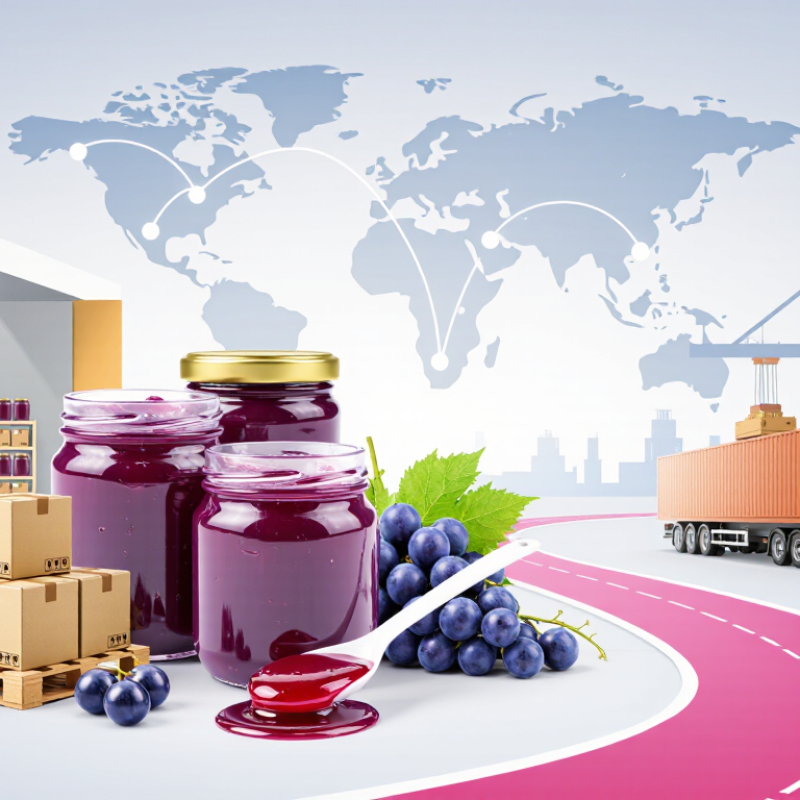
How to Source Grape Jelly in Bulk Worldwide?

Define Bulk Grape Jelly Requirements and Intended Use

Bulk grape jelly should be defined by use, not by a vague container size.

Decide whether it will fill breakfast sachets, bakery layers, dessert toppings, or foodservice tubs. Each use changes viscosity, spreadability, sweetness, and packaging needs.

For a retail-style product, set target soluble solids near 65%. Codex Alimentarius CXS 296-2009 identifies 65% soluble solids as the usual minimum for conventional jams and jellies. Reduced-sugar recipes require separate validation.

Specify grape source, fruit percentage, color range, seed and skin tolerance, pH, Brix, preservatives, allergens, and shelf life.

Do not accept “natural grape flavor” as a complete specification. That shortcut can produce a purple gel with weak fruit identity.

The first draft may be wrong.

Volume estimates need evidence.

FAOSTAT reports roughly 78 million tonnes of grapes worldwide in 2022.

Much of that crop serves fresh or wine channels.

The OIV’s 2024 report estimated 2023 global wine production at 237 million hectolitres.

That demand can compete with jelly-grade concentrate during tight harvests. Request a twelve-month supply plan, origin options, harvest timing, concentrate ratio, and batch-level certificates. Use Codex CXC 1-1969 principles for hygienic controls and documented traceability.

Ask for laboratory results, not promises.

Pilot one pallet before signing a yearly contract. That feels slower. It is usually cheaper than rejecting a full container.

Review texture after transport, storage, and actual kitchen use.

Identify Global Suppliers, Product Formats, and Manufacturing Capabilities

How to Source Grape Jelly in Bulk Worldwide?

Global sourcing starts with identifying the right supplier type. Large processors often offer consistent Brix levels, private-label production, and export documentation. Smaller manufacturers may provide flexible recipes and lower minimum order quantities. Grand View Research valued the global fruit spreads market at approximately USD 7.6 billion in 2023, with continued growth expected through 2030. This indicates strong demand, but market size alone does not prove supplier reliability.

Product format matters during evaluation. Foodservice buyers may prefer 5-kilogram pails, 20-kilogram drums, or aseptic bag-in-box systems. Retail programs usually require glass jars, squeezable bottles, or single-serve sachets. Ask for target Brix, pH, fruit percentage, viscosity, and shelf-life data.

Manufacturing capability should include hot filling, pasteurization, metal detection, batch traceability, and microbiological testing. A current certificate of analysis is essential.

USDA Foreign Agricultural Service reports on processed fruit ingredients highlight documentation, origin, tariffs, and logistics as recurring purchasing factors. Request allergen statements, ingredient specifications, packaging drawings, and export certificates before approving samples. Check whether the supplier can produce custom sweetness levels or reduced-sugar formulas. A spreadsheet helps, but it can mislead. One factory may quote less while using weaker packaging or slower port routes. Compare delivered cost, not only the product price. Sample testing should include texture after storage, leakage risk, and color stability. Some suppliers look capable on paper. Their production records may say otherwise.

Verify Ingredients, Certifications, Quality, and Food Safety Standards

Buying grape jelly in bulk worldwide requires more than comparing prices. Ingredient verification should begin with the full product specification. Request the recipe, ingredient percentages, allergen statement, country of origin, and permitted additive details. Ingredient wording matters.

Check whether the jelly contains real grape juice, concentrate, artificial flavors, or added coloring. Confirm sugar levels and pectin sources match your market requirements. Ask for current certifications, such as HACCP, ISO 22000, or an equivalent audited food safety system. A certificate alone proves little. Review its issuer, scope, expiry date, and covered production site. Request recent certificates of analysis for acidity, soluble solids, microbiological safety, and contaminants. Independent laboratory testing can expose gaps before a large shipment arrives. Use sealed samples from the intended production line, not only showroom samples. Small details matter.

Quality checks should cover texture, color, flavor, jar seals, label accuracy, and packaging strength. During inspection, record lot numbers and photograph damaged cartons. Verify traceability from raw materials to finished pallets. For international shipments, confirm storage temperatures, shelf life, and transport conditions in writing. I once treated a clean sample as sufficient evidence; that was too optimistic. Batch variation can appear after heat processing or long transportation. A practical supplier should welcome corrective-action questions and provide clear records without delays. Keep every document together, because customs, retailers, and auditors may request different evidence.

Compare Pricing, Minimum Orders, Shipping, and Import Requirements

How to Source Grape Jelly in Bulk Worldwide?

Bulk grape jelly pricing depends on fruit content, packaging, order volume, and destination. Request quotes by kilogram, not only by jar. A low unit price may hide high packaging costs. Compare factory pricing with the landed cost, including freight, insurance, duties, inspection, and port fees. Minimum orders often range from several hundred cartons to one full container. Smaller orders may cost more per unit, but they reduce storage pressure and cash risk.

Shipping choices affect both timing and product condition. Ocean freight usually offers the lowest cost for large orders, while air freight suits urgent samples or limited launches. Confirm pallet dimensions, container loading plans, delivery terms, and shelf-life at arrival. Import requirements can include commercial invoices, packing lists, certificates of origin, ingredient declarations, allergen statements, and food safety records. The correct customs classification should be verified with a qualified broker. Requirements differ by country.

Tips: Ask for a sample before negotiating a large contract. Test flavor, color, texture, seal quality, and label details. Calculate costs using realistic exchange rates. I once underestimated port storage, and the final margin suffered. That mistake still matters. Leave space for inspection delays and damaged cartons. Confirm whether the supplier handles export documents or expects the buyer to arrange them. Keep written records of every specification, revision, and approval.

How to Source Grape Jelly in Bulk Worldwide?

Indicative bulk-sourcing benchmarks for grape jelly: product cost, ocean freight, and minimum order quantity.

Sourcing Region Indicative Product Cost Typical Ocean Freight Typical MOQ Key Import Requirements
North America USD 2.80/kg USD 0.38/kg 1.0 metric ton Food facility registration, commercial invoice, packing list, product label, lot traceability
Western Europe USD 3.10/kg USD 0.42/kg 1.0 metric ton Ingredient and allergen declaration, nutrition panel, traceability records, customs documentation
East Asia USD 2.10/kg USD 0.55/kg 2.0 metric tons Export health documents, commercial invoice, packing list, certificate of origin where required
South Asia USD 1.85/kg USD 0.62/kg 2.0 metric tons Food safety certificate, ingredient specification, label compliance, import clearance documents
Latin America USD 2.25/kg USD 0.48/kg 1.5 metric tons Commercial invoice, packing list, sanitary documentation, origin and traceability records

The figures are indicative planning benchmarks for bulk shipments of shelf-stable grape jelly in food-service or industrial packaging. Final landed cost depends on formulation, packaging size, Incoterms, container utilization, destination duties, taxes, inspection fees, and seasonal freight rates. Importers should verify current tariff classification, labeling rules, food-facility requirements, and documentation with the destination customs and food-safety authorities.

Reference framework: HS heading 2007 for jams, fruit jellies, marmalades, purées, and pastes; actual classification and import requirements vary by destination.

Evaluate Samples, Negotiate Terms, and Finalize the Purchase

When sourcing grape jelly in bulk worldwide, sample evaluation should begin with a written specification. I request two production samples from separate batches. Each jar reveals color, grape aroma, sweetness, acidity, gel strength, and skin or seed particles. I spread the jelly on a cold stainless-steel spoon, then test it at room temperature. A smooth texture can hide excessive syrup. I check the ingredient list, allergen statement, nutrition panel, lot code, and remaining shelf life. Keep records. A small tasting panel helps, although personal preference can distort results. I once favored a darker sample, but later found its flavor too cooked for bakery filling. That mistake changed my review sheet.

Negotiation should cover more than price per kilogram. Confirm minimum order quantity, packaging format, pallet layout, production lead time, payment milestones, and delivery terms in writing. Ask how the supplier handles damaged cartons, temperature exposure, and short shipments. For international delivery, verify export documents, certificate requirements, and import rules with qualified local professionals. Do not rely on chat promises. Currency changes, port delays, and harvest variation can affect the final cost. I prefer a small pilot order before committing to yearly volume, even when the quoted price looks attractive.

Before finalizing, compare the approved sample with the pre-shipment specification. The seal should be intact. Request a batch-specific certificate of analysis, packing list, invoice, and traceability records. Confirm the label language and date format for the destination market. Include an inspection window and a clear remedy for nonconforming goods. A purchase order should match every agreed detail, including cap type and case count. Leave room for doubt. A rushed signature can turn a minor texture difference into thousands of unusable jars. Final approval should come from both procurement and quality personnel, not one hurried buyer.

Article Source: