

Choosing the right Custom Indoor Trampoline manufacturer requires more than comparing prices or colorful product photos. It demands evidence, technical knowledge, and practical experience. This guide introduces ten leading manufacturers serving indoor entertainment centers, family activity parks, schools, resorts, and commercial recreation spaces worldwide.
Each company is considered through clear criteria. These include design capability, material quality, production experience, safety engineering, customization options, installation support, and after-sales service. A reliable manufacturer should explain its frame structure, spring or elastic-system design, padding thickness, anchoring method, and inspection process. Details matter. A loose edge pad or poorly planned access route can affect daily operations and visitor confidence.
Look closely.
The selection also considers how manufacturers manage complex projects. Some clients need a compact trampoline zone for a shopping center. Others require interconnected platforms, climbing walls, foam pits, themed graphics, or obstacle elements across a large venue. Strong suppliers should provide measured layouts, realistic renderings, load guidance, maintenance recommendations, and responsive communication. Certifications and test documentation may support trust, but they should be reviewed carefully rather than accepted without questions.
No ranking can fit every business perfectly. That is worth admitting. A manufacturer with excellent engineering may not suit a small budget or a short installation timeline. Another supplier may offer attractive customization but limited regional support. This overview therefore aims to help readers compare strengths, identify potential weaknesses, and ask better questions before signing a project agreement. Safety, durability, and long-term service should remain central throughout the decision.
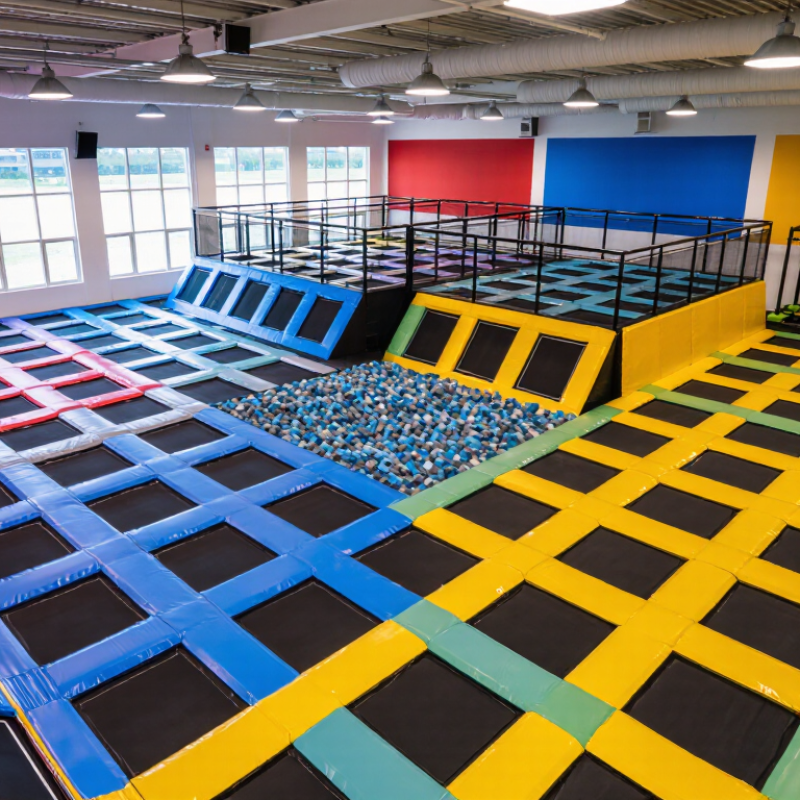
A custom indoor trampoline manufacturer does more than produce colorful jumping surfaces. It converts a venue’s dimensions, visitor flow, ceiling height, and emergency routes into a tested recreation system. Engineers should review load calculations, anchor points, padding thickness, net tension, and fall zones. ASTM F2970 provides a useful framework for trampoline court design, operation, inspection, and maintenance.
Safety data makes this work practical, not cosmetic. The U.S. Consumer Product Safety Commission has estimated nearly 100,000 trampoline-related injuries treated in emergency departments annually in the United States. A reliable manufacturer therefore supplies inspection records, installation drawings, user-capacity guidance, and replacement schedules. IAAPA industry guidance also emphasizes documented staff training and routine risk checks. Yet paperwork alone is insufficient. A poorly installed pad can shift beneath a child’s foot. That detail deserves more attention than a glossy rendering.
Tips: Ask for site-specific engineering documents, material test results, and maintenance procedures. Check whether the manufacturer can adapt obstacles for different age groups and accessibility needs. Request evidence from completed installations, not only computer images. One weakness remains common: buyers often compare prices before comparing lifecycle costs. Cheaper foam may compress quickly, creating repairs and downtime. A better decision reviews durability, cleaning access, spare-part availability, and local installation support. Still, even careful specifications need human review before opening day.
Designing a custom indoor trampoline starts with the building, not the trampoline. Manufacturers measure ceiling height, floor area, columns, entrances, and emergency access. They then create a digital layout that separates jumping zones, walkways, and viewing areas. Small details matter. A narrow corner can change the entire plan.
Engineers select steel frames, jumping mats, springs, padding, and protective netting according to expected use. Materials must handle repeated impact, moisture, and daily cleaning. Computer-aided drawings help control dimensions, but physical samples remain essential. A frame may look accurate on screen and still feel awkward during assembly. Prototype testing can reveal uneven tension, hard edges, or poor padding alignment.
Production usually includes cutting, welding, surface treatment, sewing, assembly, and inspection. Welds are checked for consistency, while mats are examined for stitching strength and surface damage. Installers test clearances and anchor points inside the finished venue. Manufacturers also review applicable local safety requirements before delivery. This process is careful, but not flawless. A rushed measurement can create expensive rework. A smart team records these mistakes and improves its inspection checklist. Reliable custom manufacturing depends on traceable materials, trained workers, documented testing, and honest communication with the buyer.
Ranking the Top 10 Custom Indoor Trampoline Manufacturers Worldwide requires more than comparing prices. Safety evidence should lead the assessment. The WHO’s Global Status Report on Physical Activity 2022 found that 1.4 billion adults were insufficiently active in 2016. That figure supports continued demand for structured indoor recreation. However, demand must not replace engineering discipline.
Evaluate frame steel, welding quality, foam density, mat stitching, and anchor design. Ask for laboratory test records, material traceability, and production samples. The CPSC’s trampoline safety review estimated about 100,000 related emergency department injuries in the United States during 2009. The figure is old, but it remains a useful warning. A strong supplier should explain impact protection, fall zones, user capacity, and maintenance intervals clearly.
Customization also needs measurable controls. Review CAD drawings, installation tolerances, fire-performance documents, and replacement-part availability. Factory audits should examine incoming materials, weld inspection, packing methods, and final load tests. Certificates alone are not enough. Standards such as ASTM F2970 can support evaluation, but buyers must verify scope and test dates. Warranty terms should cover commercial use, not only household conditions. After-sales response matters when one damaged mat can close a busy attraction. Some manufacturers present attractive designs yet provide weak maintenance guidance. That weakness deserves scrutiny. Price comparisons are imperfect, because shipping, installation, training, and downtime may be excluded. A reliable evaluation weighs lifecycle cost, documented safety, customization accuracy, and operational support together.
The top ten custom indoor trampoline manufacturers worldwide are usually judged by more than product appearance. Experienced suppliers understand how frame geometry, spring tension, padding, and landing zones affect daily safety. They design for family centers, training halls, hotels, and compact entertainment venues. A serious manufacturer should provide material specifications, load testing records, installation drawings, and maintenance guidance. Factory experience matters. So does transparent communication.
Customization may include platform size, wall angles, foam pits, climbing elements, colors, and themed surfaces. Reliable engineering teams check floor conditions before confirming dimensions. They also consider ventilation, visitor flow, emergency access, and cleaning routines. Small details matter. Weld quality matters. Stitching matters. Protective padding should remain secure after repeated use. Independent inspection can add confidence, although buyers should verify the inspection scope carefully.
The strongest global manufacturers often combine in-house design with controlled production and documented quality checks. They can explain replacement procedures instead of promising unrealistic durability. I would question any supplier offering identical solutions for every venue. That approach may reduce cost, but it can ignore local space limits and user behavior. A polished catalog is not proof of technical ability. Buyers should request references, sample drawings, warranty terms, and evidence from completed installations. No ranking is permanent; production consistency and after-sales support can change over time.
Selecting among the top ten custom indoor trampoline manufacturers requires more than comparing colors or quoted prices. The stronger suppliers begin with a site survey, ceiling-height check, traffic estimate, and written risk assessment. That process reveals practical differences. One factory may offer curved layouts, recessed frames, quiet springs, and branded padding, while another limits every dimension. Customization should serve movement, cleaning, and supervision.
Ask for documented material specifications, load testing, edge-protection details, and inspection records. Relevant standards may include ASTM or EN requirements, but the exact requirement depends on equipment type and location. Do not accept a certificate without checking its scope, date, and issuing body. Safety labels alone are not enough. Look for flame-resistant surfaces, secure anchor points, visible seams, and padding that stays firm after repeated use. A useful manufacturer explains maintenance intervals instead of promising zero risk.
Service quality often separates a reliable supplier from an attractive catalogue. Compare drawing revisions, sample approval, installation training, spare-mat availability, and response times for damaged padding. Request a replacement schedule before opening day. Some suppliers communicate quickly during sales, then become vague about repairs. That weakness is easy to miss. Ask for references from comparable venues and inspect completed installations, including older ones. Even careful buyers overlook cleaning access or staff training; those gaps deserve serious review. A perfect comparison is impossible because quotes rarely include identical installation conditions. That uncertainty should be recorded, not hidden.
Anonymous comparison of common commercial manufacturer profiles. Safety requirements and certification documents should be verified for each project, jurisdiction, and installation site.
| Rank | Anonymous Manufacturer Profile | Typical Customization Scope | Common Indoor Trampoline Formats | Primary Safety Benchmark | Safety Documentation to Request | Padding & Protection Options | Engineering & Layout Service | Installation Support | Warranty Structure | Typical Lead-Time Range | Best Fit |
|---|---|---|---|---|---|---|---|---|---|---|---|
| 1 | Large commercial turnkey supplier | Full-zone design, custom dimensions, colors, graphics, access points, and integrated attractions | Open jump courts, dodgeball courts, basketball lanes, foam-pit access | ASTM F2970 target | Structural calculations, material specifications, installation drawings, inspection records | Replaceable edge pads, impact-absorbing covers, protected steel frames, netted transition zones | 3D layout, capacity planning, circulation design, and risk-assessment support | Usually available through regional teams or approved installers | Separate coverage for structure, springs, mats, and consumable components | Approximately 10–20 weeks after approved drawings | Large family entertainment centers and multi-attraction venues |
| 2 | Custom modular system supplier | Modular bay sizes, adjustable platform heights, selectable obstacle modules, and color packages | Rectangular courts, angled walls, launch platforms, and modular challenge zones | ASTM F2970 target | Component test reports, load information, anchoring details, and maintenance schedule | High-density foam borders, coated vinyl covers, wall pads, and reinforced landing areas | Remote planning with CAD files and standard configuration libraries | On-site installation may be offered as an optional service | Typically limited warranty on frames with shorter coverage for soft goods | Approximately 8–16 weeks | Medium-sized venues needing future expansion |
| 3 | Premium design-and-build specialist | Architectural integration, branded-but-anonymous color schemes, custom obstacles, and themed interiors | Immersive trampoline parks, performance zones, and mixed-use activity areas | ASTM F2970 plus local code review | Professional engineering review, fire-rating information, evacuation plan, and commissioning report | Custom upholstery, concealed transitions, wall cushioning, and specialized landing systems | Full concept design, traffic-flow modeling, rendering, and project coordination | Full project installation and commissioning commonly available | Project-specific warranty with scheduled service packages | Approximately 16–28 weeks | High-end commercial developments and destination attractions |
| 4 | Export-focused factory supplier | Standardized custom sizes, color selection, logo-free graphics, and configurable accessories | Basic open courts, foam pits, wall trampolines, and junior areas | ASTM F2970 or EN-based review | Factory quality records, welding information, material certificates, and packing list | Standard protective pads, PVC-coated covers, safety nets, and spring guards | Basic floor plans and installation manuals; advanced engineering may be separate | Remote technical guidance is common; local installation must be arranged | Parts warranty commonly separated from labor and travel costs | Approximately 6–14 weeks, excluding shipping | Importers and cost-sensitive independent operators |
| 5 | Safety-led indoor recreation supplier | Safety zoning, controlled entry systems, age-group separation, and customized supervision points | Family courts, toddler-compatible areas, low-impact zones, and training lanes | ASTM F2970 with operational controls | Risk assessment, user rules, inspection checklist, cleaning guidance, and staff-training materials | Enhanced perimeter padding, reduced-gap transitions, non-slip surfaces, and net barriers | Safety review, operating-procedure development, and staff orientation | Installation supervision and post-installation safety inspection may be available | Standard product warranty plus optional preventive-maintenance agreement | Approximately 10–18 weeks | Operators prioritizing documented safety procedures |
| 6 | Sports and training equipment specialist | Custom rebound characteristics, lane dimensions, training layouts, and performance accessories | Training trampolines, tumbling combinations, wall units, and skill-development areas | EN 13219 or ASTM review | Product specifications, test methods, anchoring requirements, and user-weight limits | Gym-grade mats, reinforced frames, replaceable spring covers, and landing mats | Sports-layout planning and equipment positioning support | Technical installation instructions; specialist installation may be optional | Component-specific warranty with service-part availability | Approximately 6–12 weeks | Training centers, schools, clubs, and athletic facilities |
| 7 | Compact venue solutions supplier | Space-efficient layouts, corner installations, short-run configurations, and custom access routes | Small courts, wall-to-wall trampolines, compact foam pits, and activity corners | Applicable local commercial standard | Site measurements, anchoring plan, clearance requirements, and maintenance instructions | Low-profile padding, corner guards, wall pads, and covered frame sections | Remote measurement review and 2D layout planning | Installation partner availability varies by region | Basic limited warranty with optional replacement-part plans | Approximately 6–12 weeks | Hotels, retail centers, compact entertainment venues, and small gyms |
| 8 | Integrated soft-play and trampoline supplier | Combined soft play, climbing, slides, trampolines, crawl areas, and themed panels | Multi-level play structures, toddler zones, trampoline rooms, and mixed-age attractions | ASTM F1918 / ASTM F2970 review | Play-equipment test documents, fire-performance data, inspection forms, and cleaning protocol | Foam obstacles, padded columns, netting, soft barriers, and sealed upholstery | Full play-area zoning, age separation, circulation planning, and visual design | Turnkey installation is commonly offered for larger projects | Warranty normally varies by equipment category and upholstery type | Approximately 12–24 weeks | Indoor playgrounds and family entertainment centers |
| 9 | Regional engineering and installation contractor | Site-adapted dimensions, building-interface details, local materials, and retrofit solutions | Renovated courts, replacement systems, mezzanine installations, and custom retrofits | Local code plus project engineering | Stamped drawings where required, load data, fixing details, inspection report, and handover file | Site-fitted padding, custom wall protection, replacement mats, and modified barriers | Detailed site survey, structural coordination, and construction-stage support | Strongest option for local installation, inspection, and repair response | Labor and materials may be covered separately under a service contract | Approximately 8–18 weeks | Existing buildings, refurbishments, and projects with difficult site conditions |
| 10 | Value-oriented configurable supplier | Limited size selection, standard colors, basic accessories, and simple custom layouts | Entry-level open courts, small foam pits, and recreational jump areas | Verification required | Written specifications, material declarations, assembly instructions, and inspection checklist | Standard pads, spring covers, perimeter netting, and basic wall cushioning | Template layouts and remote technical assistance | Usually customer-managed or handled by an independent installer | Shorter standard warranty; replacement parts should be confirmed before purchase | Approximately 5–10 weeks, excluding shipping and installation | Small operators with straightforward layouts and controlled budgets |
Note: ASTM F2970 addresses commercial trampoline courts, while EN 13219 applies to certain training trampolines and ASTM F1918 covers soft contained play equipment. The applicable standard depends on the equipment type, venue use, and local regulations. Always request current certificates, engineering documents, installation records, and maintenance requirements before purchase.