



Best China Slide Out Shelves Suppliers for Global Buyers?

Choosing the best China slide out shelves suppliers requires more than comparing catalog prices. Global buyers need stable quality, clear communication, and evidence of manufacturing control. A shelf may look excellent in a product photo, yet feel loose after repeated daily use. The drawer should glide quietly, stop firmly, and support its stated load without bending.

Jim Karr, founder of Rev-A-Shelf and a respected cabinet-storage specialist, once said, “Good storage should disappear into the room, but work hard every day.” This idea remains practical. Reliable slide out shelves should save space while surviving real kitchen conditions. Consider humid cabinets, heavy cookware, narrow pantry frames, and thousands of opening cycles. Small details matter. Steel thickness matters. So does hardware alignment.

This guide introduces Chinese suppliers that serve international projects, distributors, and cabinet manufacturers. It examines product range, customization ability, slide performance, load testing, packaging, export experience, and after-sales support. Factory audits, sample orders, and technical drawings can reveal more than a polished website. Ask for material specifications, installation tolerances, warranty terms, and production lead times.

There is no perfect supplier.

A low quote can hide thin steel, weak plating, or inconsistent assembly. A premium factory may still miss deadlines during peak seasons. Buyers should test samples before placing large orders and compare performance under realistic weight. Certifications are useful, but they do not replace inspection. With careful evaluation, China can offer competitive slide out shelves without sacrificing durability, safety, or professional service.
Best China Slide Out Shelves Suppliers for Global Buyers?

What Are Slide-Out Shelves and Why Do Global Buyers Choose China?

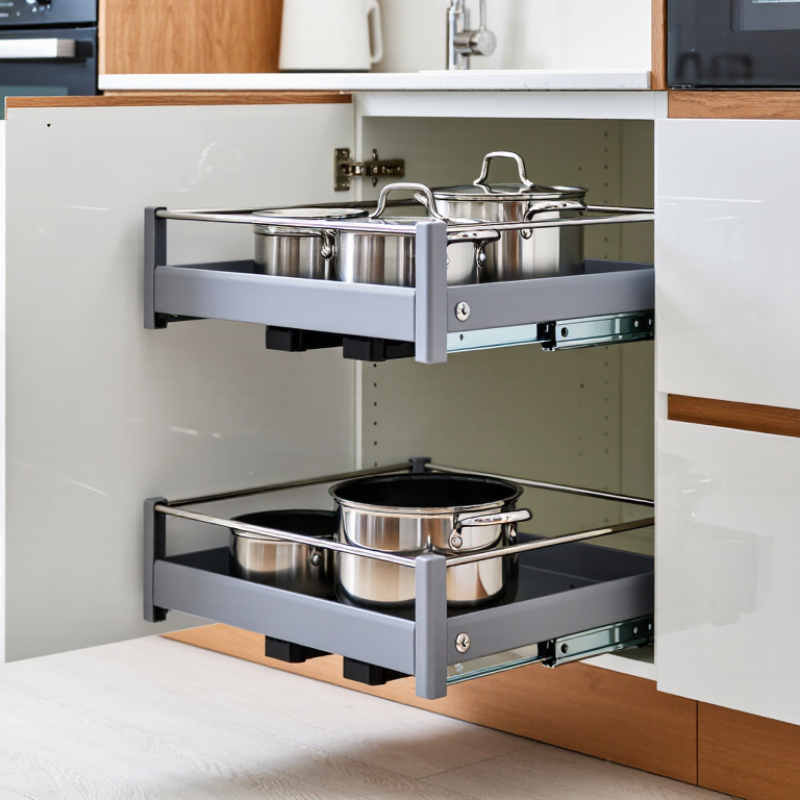
Slide-out shelves are cabinet trays mounted on runners, allowing cookware, pantry goods, or cleaning supplies to move forward instead of hiding at the back. A full-extension rail exposes nearly the whole shelf; soft-close hardware reduces impact. Small detail. Load capacity, cabinet opening width, runner quality, and installation accuracy matter more than a polished product photo.

The demand reflects a practical storage problem. Houzz’s 2024 U.S. Kitchen Trends Study reports that 76% of renovating homeowners upgraded their cabinets. Pull-out storage makes deep base cabinets easier to use, especially when a user needs to reach heavy pots without kneeling or unloading the front row. It is not a cure-all. Poorly measured shelves can rub against cabinet doors or waste valuable space.

Global buyers often consider China because its manufacturing base supports broad sourcing of metal runners, formed steel, wood panels, and customized dimensions. UNIDO’s International Yearbook of Industrial Statistics 2024 puts China’s share of global manufacturing value added at roughly 31% in 2022. Scale can help with production capacity and component choice, but it does not guarantee consistent quality. Buyers should request load-test details, finish samples, and a dimensional drawing before approving production. A small gap can matter.

Which Types of Slide-Out Shelves Suit Different Storage Applications?

Slide-out shelves work best when their design matches the items and the way people reach them. In kitchen base cabinets, full-extension trays bring pots and small appliances into view. A low-sided shelf suits cookware; deeper sides help keep bottles upright. Narrow pull-outs can use gaps beside a refrigerator for spices or oils. Measure the cabinet opening, not just its outer width. A few millimeters can matter.

For pantry storage, sturdy solid trays handle jars, cans, and heavier dry goods. Wire shelves allow airflow and make crumbs easier to spot, but small packets may slip through. Choose runners with a load rating that comfortably exceeds the expected weight. Heavy trays need secure cabinet fixing, too. This detail is easy to overlook.

Garages and utility rooms often need tougher shelves for tools, cleaning supplies, or storage bins. Raised edges help contain loose parts, while smooth trays are simpler to wipe after spills. In wardrobes, shallow pull-outs make folded shirts and accessories easier to scan; deep trays can bury smaller items. Think about clearance, humidity, cleaning, and how often each shelf will be used. There is no universal best option. Even a well-measured shelf can feel awkward if its handle is blocked or its contents are stacked too high.

Best China Slide Out Shelves Suppliers for Global Buyers? - Which Types of Slide-Out Shelves Suit Different Storage Applications?

Slide-Out Shelf Type Common Construction Typical Load Range* Suitable Storage Applications Key Selection Considerations
Wire pull-out basket Coated steel-wire basket with side-mounted slides About 15–30 kg per shelf Kitchen cabinets, pantry cupboards, laundry storage, and general-purpose cabinets Open wire construction allows airflow and visibility. Check basket dimensions, coating, slide extension, and compatibility with the cabinet opening.
Solid-bottom cabinet shelf Wood, plywood, or melamine-faced panel fitted to a slide mechanism About 20–45 kg per shelf Cookware, small appliances, pantry goods, and items that need a stable, flat surface Confirm panel thickness, edge finishing, moisture exposure, and the slide’s rated capacity. Capacity depends on the panel and its support as well as the runners.
Full-extension ball-bearing shelf Panel or metal shelf mounted on telescopic ball-bearing slides About 20–45 kg per shelf Deep base cabinets, utility cabinets, and storage where access to the back of the shelf matters Full extension brings most of the shelf outside the cabinet. Verify closed length, extension length, required side clearance, and load rating.
Soft-close pull-out shelf Wood or metal shelf with a soft-close slide system About 15–40 kg per shelf Residential kitchens, bathrooms, and other cabinets where quieter closing is preferred Check the system’s rated load, door and cabinet clearances, adjustment range, and whether the soft-close mechanism is integrated into the slides.
Heavy-duty industrial pull-out shelf Reinforced steel tray or platform with heavy-duty slides About 45–100 kg or more per shelf, depending on the system Workshop cabinets, tool storage, service areas, and equipment enclosures Capacity is highly dependent on slide length, mounting method, and whether the shelf is fully extended. Confirm the manufacturer’s rated load and installation requirements.
Under-sink pull-out organizer Metal or plastic basket system, often with a shaped or tiered layout About 10–25 kg per unit Kitchen and bathroom cabinets containing pipes, cleaning products, or toiletries Measure around plumbing, traps, and door hinges. Compare the organizer’s usable width and depth with the cabinet’s internal dimensions.
Pantry pull-out unit Vertical frame with multiple wire or solid-bottom baskets About 5–15 kg per basket; check total-unit rating Tall pantry cabinets for packaged food, jars, and everyday kitchen supplies Check cabinet height and width, number of baskets, door mounting method, and total load capacity. Distribute weight evenly across baskets.
Corner-cabinet pull-out system Linked trays or baskets on a pivoting or sliding mechanism About 5–15 kg per tray; check system rating Accessible storage in blind-corner kitchen cabinets Measure the corner cabinet’s opening, interior dimensions, and door arrangement. Confirm the mechanism’s clearance and installation side.
Buyer note: Load figures are indicative ranges for common product categories, not universal specifications. Actual capacity varies by slide model, shelf material, dimensions, mounting method, and test conditions. Request the supplier’s technical drawing, installation instructions, and load-rating documentation before ordering.

How to Evaluate China-Based Slide-Out Shelf Suppliers

Evaluating China-based slide-out shelf suppliers starts with the product, not the catalogue. Ask for drawings that show dimensions, mounting points, and full-extension clearance. Request the rated load and how it was tested. A shelf holding a static weight may behave differently after repeated opening. Ask for cycle-test results, material specifications, and corrosion-test details. Small details matter. Check whether the finish covers edges and joints, where moisture can collect. Compare a production sample with the approved drawing, including slide smoothness and noise. One sample is useful, but it cannot prove consistent batch quality.

Then examine how the supplier controls production. Ask who checks incoming steel, dimensions, and final assembly, and how defects are recorded. Request recent inspection records or arrange a third-party inspection before shipment. Confirm packaging with a drop or handling test; bent rails often arrive from weak corner protection. Ask for realistic lead times, minimum order quantities, spare-part availability, and clear answers about design changes. Communication is evidence, too. A polished quotation means little if technical questions go unanswered. I have seen buyers focus on unit price and overlook carton size, then face higher freight costs. That is an easy assumption to make, and worth checking early. Compare suppliers using the same specifications, not different sample configurations.

What Quality, Customization, and Compliance Standards Should Buyers Check?

For slide-out shelves, quality starts with repeatable measurements, not polished product photos. Ask suppliers for dimensional tolerances, load ratings, and test conditions. A shelf holding 30 kilograms on paper may behave differently when fully extended. Check whether testing includes repeated opening and closing, uneven loading, and side-to-side movement. Request samples and inspect the rails, fasteners, welds, and edge finish by hand. Small details matter.

Customization should be confirmed against a drawing before production. Specify cabinet opening width, shelf depth, mounting position, handle clearance, and preferred materials. Ask how the supplier manages revisions and keeps approved samples on file. A useful trial order can reveal fit problems before a large shipment. It may still miss real installation conditions, so test shelves inside representative cabinets.

Compliance depends on the destination market and the product’s materials and intended use. Request current test reports, material declarations, and traceable batch records; verify that report details match the actual shelf configuration. For metal parts, ask about coating performance and corrosion testing. For wood components, check applicable sourcing and emissions documentation. Paperwork alone is not proof. Have an independent laboratory review key claims when risk or order volume justifies the cost.

How Do International Buyers Manage Pricing, Shipping, and After-Sales Support?

International buyers should compare landed cost, not just the factory price. Ask suppliers to separate unit pricing, packaging, tooling, inland transport, and shipping charges. For slide-out shelves, confirm the quoted load rating, dimensions, finish, and carton count. Small specification changes can affect both the price and the container plan.

Freight needs a buffer. UNCTAD’s Review of Maritime Transport 2024 reported that global maritime trade grew 2.4% in 2023, while route disruptions increased uncertainty for shipping schedules and costs. Request quotes with a validity period, named Incoterm, port details, and clear rules for surcharges. Check whether the shipment uses moisture protection; a damp carton can leave a polished steel runner scratched or corroded. A low quote is not always a low landed cost.

Plan after-sales support before placing the order. Agree on inspection photos, batch labels, spare-part availability, and a response time for damage or dimensional issues. Ask how replacement runners will be identified from the original order records. Keep one sample set for comparison. It helps. A supplier may promise quick support, but vague promises are hard to use across time zones. Written procedures matter more than reassuring calls, though even a good checklist cannot prevent every shipping problem.

This planning benchmark shows the main components international buyers typically review when sourcing slide-out shelves from China. Product pricing usually represents the largest share of landed cost, while freight, import charges, inland delivery, and after-sales reserves should be evaluated before selecting a supplier.