



China’s freeze-dried pet food sector includes manufacturers, private-label producers, and export-focused suppliers. Comparing them takes more than checking product photos or a low quotation. Buyers should examine ingredient specifications, production controls, traceability, and the supplier’s ability to provide consistent batches. Freeze Dried Dog Food can look simple in a sample pouch, yet the sourcing and processing behind each piece matter.
Veterinary nutritionist Dr. Lisa M. Freeman’s published guidance supports a useful principle: “A food’s format alone does not establish its nutritional value.” This is a paraphrase, not a verbatim quotation. It is a practical reminder to review the finished product’s nutritional adequacy, feeding directions, and supporting documentation—not just its freeze-dried label. Small details count. A clear batch record or a prompt, specific answer can say more than polished marketing.
This guide looks at leading China-based suppliers through a buyer’s lens: product range, manufacturing transparency, customization, export experience, and communication. Supplier rankings can shift as capabilities and product lines change, so treat them as a starting point for due diligence, not a guarantee. Ask for current specifications and verify claims directly. No supplier profile tells the whole story. And honestly, a neat brochure can still leave important questions unanswered.
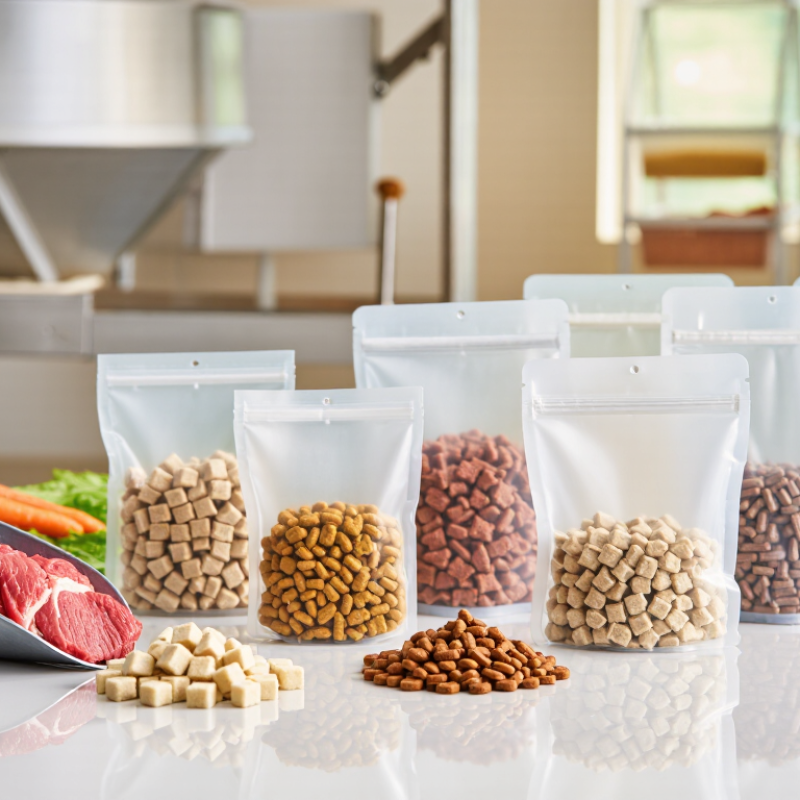
Freeze-dried dog food begins with prepared ingredients, often meat, organs, and selected vegetables. The mixture is portioned into pieces or patties, then frozen. Inside a vacuum chamber, ice turns directly into vapor, leaving a dry, lightweight food. A final drying stage removes more moisture. The shape stays recognizable. Add water, and many pieces soften again.
That process preserves food without conventional high-heat cooking, but it does not automatically make raw ingredients sterile. The FDA’s 2018 survey tested 196 commercially available raw pet foods: 15 contained Salmonella, and 32 contained Listeria monocytogenes. Those figures cover raw pet foods broadly, not freeze-dried products alone. Still, they matter when assessing handling. Keep scoops and bowls clean, follow the supplier’s storage directions, and wash hands after serving. A dry surface can look reassuring. It is not proof of safety.
For buyers comparing Chinese suppliers, ask for the actual drying method, moisture specifications, and batch-level microbiological test results. Request clear ingredient and rehydration guidance, too. Freeze-dried food is not one uniform recipe. Drying time, piece size, and starting ingredients can all affect texture and consistency. The label may not tell the whole story. Ask for evidence.
China’s freeze-dried dog food supplier market is organized by capability, not just company size. Some factories specialize in freeze-drying and packing; others manage formulation, sourcing, production, and export coordination. The boundary is not always clean. One site may make products for several customers while also selling its own formulations.
The 2024 China Pet Industry White Paper reports that urban dog and cat spending reached RMB 279.3 billion in 2023. This figure covers the wider pet market, not freeze-dried food alone. Still, it helps explain why suppliers serve varied needs, from small trial runs to larger private-label orders. Small batches matter.
Buyers typically compare ingredient controls, batch traceability, drying capacity, and packaging options. Ask for recent batch records and clear ingredient specifications, rather than relying on a polished sample alone. A crunchy sample can hide uneven pieces or excess powder in the bag. Factory audits and independent product testing provide useful checks, though neither guarantees every future batch will match. Supplier categories can overlap, so describe each company by its actual production role, not by a broad “manufacturer” label.
Typical roles and their involvement across the supply chain
This qualitative role map shows common areas of involvement, not market share, supplier counts, or a company ranking. Suppliers may combine roles, and actual capabilities vary. Specialized processors focus on freeze-drying, while OEM/ODM manufacturers typically coordinate several production stages.
China’s leading freeze-dried dog food suppliers tend to be manufacturers with dedicated pet-food lines, reliable meat sourcing, and export experience. Factory size alone is a weak measure. Strong suppliers can explain how ingredients are received, processed, and tested, with records tied to individual production batches.
Look for clear specifications on meat content, moisture levels, and packaging. Freeze-dried pieces should feel dry and hold their shape; pouches should resist moisture and air. Ask whether the supplier uses documented microbial controls and can share recent test reports. Details matter. A polished brochure is not proof of consistent production.
The market includes large contract manufacturers and smaller specialists focused on custom formulas or particular proteins. The best fit depends on order volume, traceability needs, and how much development support a buyer expects. Still, paperwork can look better than a plant visit. If possible, compare samples from different batches and ask specific questions about sourcing changes. One limitation: supplier claims are not equal evidence, and public information rarely supports a dependable ranking.
Comparing Chinese freeze-dried dog food suppliers starts with the evidence behind each claim. APPA’s 2024 State of the Industry report estimates U.S. pet-industry spending at $152 billion in 2024. That figure covers the wider industry, not freeze-dried food alone, but it shows why buyers should ask for product-specific records. Request recent laboratory results for each recipe, including moisture, protein, fat, and microbiological testing. Check that the tested sample matches the product and production site you plan to buy from. Paperwork should be traceable. A certificate without a clear scope or valid date tells you little.
Capacity needs more than a large annual output number. Ask how many freeze-drying units operate, how batch size affects consistency, and what lead times look like during peak seasons. Request production records from several batches, plus details on ingredient sourcing and packaging controls. A sample can look excellent while routine production varies. That is easy to miss. Certifications can help, but verify the issuing body, covered facility, and renewal status directly. Treat food-safety certifications and nutritional adequacy documentation as separate checks; neither replaces the other. I would also ask what happens when a batch fails specification. The answer may be imperfect, but a specific corrective-action record is more useful than a polished sales promise.
When comparing freeze-dried dog food suppliers in China, look beyond export claims and glossy factory photos. Ask for the production site’s audit scope, current food-safety certificates, ingredient traceability, and batch-specific test results. Check whether the supplier can show moisture and water-activity results, microbiological testing, and controls between drying and packing. Paperwork is not proof. Match each certificate to the actual factory and product line.
FEDIAF’s 2024 European Pet Population and Market report estimates 299 million pets in Europe, but broad pet-market demand does not verify any supplier’s quality. Request a pilot batch and compare its appearance, smell, piece size, and packaging seal with the specification. Ask how raw materials are approved, how process changes are recorded, and what happens when a batch fails testing. Small details matter. A polished audit can still miss a weak handoff between drying and packing, so a remote review should not replace an independent factory assessment. Check shelf-life evidence under realistic shipping and storage conditions, too.
Supplier qualification checklist for comparing shortlisted manufacturers. Evaluate each factory using current documents, product-specific evidence, and independent verification rather than relying on a supplier’s marketing claims.
| Evaluation dimension | Evidence to request | Strong sourcing signal | Warning sign |
|---|---|---|---|
| Legal identity and production scope | Current business registration details, factory address, applicable feed or pet-food production permits, and a list of products covered by those documents. | The legal entity, manufacturing site, product category, and proposed contract party match across documents and can be independently checked. | Documents are expired, belong to another entity or site, or do not cover the product category being quoted. |
| Food-safety management | Current food-safety certificates, audit reports, scope statements, corrective-action records, and the documented hazard-control plan for the specific production site. | Certificates are valid and their scope includes the relevant facility and activity. Controls are supported by records, not certificates alone. | A certificate is presented as a guarantee of product safety, but the site, scope, or validity cannot be confirmed. |
| Raw-material traceability | Approved-supplier list, ingredient specifications, incoming inspection records, origin information, and a sample lot-tracing exercise. | The factory can trace ingredients from supplier and receiving lot through production to finished-product batch and customer shipment. | Ingredient origins are unclear, substitutions are made without approval, or batch links cannot be demonstrated. |
| Freeze-drying process control | Process flow, critical process parameters, equipment and sanitation records, batch logs, and validation or verification records for the proposed recipe and pack size. | Documented controls are specific to the product and batch; deviations are recorded, investigated, and resolved before release. | The supplier relies on a generic process description or cannot provide consistent batch records. |
| Microbiological and chemical testing | Recent product-specific laboratory reports, test methods, sample identification, laboratory details, and the factory’s release specifications. | Testing covers hazards and composition relevant to the ingredients and destination market. Acceptance limits align with applicable law and the buyer’s written specification. | Reports are unrelated to the product or batch, lack methods or sample details, or use limits that are not explained. |
| Moisture and water activity | Finished-product moisture and water-activity specifications, batch results, test methods, and supporting shelf-life data. | Limits are set for the specific product, measured consistently, and linked to validated packaging and storage conditions. A water activity at or below 0.60 is often used as a microbial-growth-control benchmark, but it does not by itself prove the product is pathogen-free. | Only a general “dry” claim is offered, or no batch results and shelf-life rationale are available. |
| Nutrition and product claims | Full formulation, guaranteed analysis, nutrient calculations or test results, feeding directions, and substantiation for claims such as “complete,” “balanced,” or “single ingredient.” | Labels and claims are reviewed against the requirements of the intended destination market and are consistent with the formula and test evidence. | Claims are unsupported, ingredient percentages are withheld without a workable confidentiality process, or label copy is reused across different formulas. |
| Packaging and shelf life | Packaging material specification, seal-integrity checks, barrier information, storage instructions, shelf-life study or rationale, and retained-sample policy. | The pack is suitable for the product’s moisture and oxygen sensitivity; shelf life is supported under stated storage conditions and the proposed pack format. | Shelf life is quoted without supporting evidence, or packaging changes are made without review and approval. |
| Export and destination-market readiness | Previous shipment-document examples with confidential details removed, proposed commercial and health documents, ingredient declarations, and confirmation of destination-specific requirements. | The exporter identifies the applicable requirements for the buyer’s country and confirms documents and product eligibility before production and shipment. | The supplier assumes one set of documents works for every country or cannot explain who is responsible for export compliance. |
| Quality complaints and recall readiness | Written complaint and recall procedures, incident contacts, batch coding examples, mock-recall results, and product-liability arrangements. | The factory can promptly identify affected lots, customers, and ingredient batches, and has a documented escalation process. | Batch codes are missing or inconsistent, or responsibilities for investigating and resolving safety issues are undefined. |
| Commercial and supply capability | Written quotation, minimum order quantity, production lead time, capacity assumptions, payment terms, sample policy, and change-control terms. | Costs and lead times are itemized; capacity claims are consistent with the production plan; formula, ingredient, and packaging changes require buyer approval. | Unusually low pricing is not explained, key costs are omitted, or substitutions and schedule changes are permitted without notice. |
| Pre-shipment verification | Approved golden sample, signed product specification, batch-specific certificate of analysis, inspection plan, and agreed independent inspection or testing arrangements. | Acceptance criteria are agreed before production, and the buyer can verify a shipment against the approved sample and specification. | There is no written specification, or the factory refuses reasonable batch-level verification. |
How to use this table: Compare factories against the same written specification and destination-market requirements. No single certificate or test result establishes that a supplier is universally compliant; verify document scope, product applicability, and current validity before placing an order.