




Global buyers comparing Round Trampoline manufacturers face more than a price decision. They need products that fit local users, available space, shipping plans, and after-sales expectations. A reliable supplier should explain frame steel, joint design, spring or elastic-band options, mat materials, enclosure construction, and weight limits in clear terms. Ask for current test reports and production details, not only polished catalog images. Details matter.
This guide introduces manufacturers serving international buyers and the questions that help distinguish capable partners from attractive listings. Compare product range, factory experience, customization options, quality checks, packaging, lead times, and communication before requesting a quotation. A trampoline may look sturdy in a showroom, yet weld consistency, net attachment points, and replacement-part access matter after months outdoors. Small details count. Buyers should also confirm how stated safety limits were determined and whether the documentation matches the exact model being purchased. Requirements and service expectations differ by market, so one checklist cannot answer every question. That is easy to overlook. Use the profiles as a starting point, then verify claims directly with each manufacturer. No supplier is perfect, and even a careful comparison can miss something. The goal is not to find the cheapest Round Trampoline, but a supplier whose evidence, product design, and support match the buyer’s real needs.
Round trampoline manufacturers serve different buyers, from garden retailers to schools and sports distributors. Their products may look similar online, but construction details can vary. Frame tube thickness, galvanized steel finish, spring count, and mat stitching affect durability. On a sample, inspect welds, leg stability, and how the safety net connects. Small details matter.
The market also reflects different shipping and customer needs. A compact carton can reduce freight costs, yet dense packing may crease soft components. Ask how parts are protected and whether replacement nets, springs, and pads can be ordered later. Request production samples and reports for relevant product tests. A catalog alone is not enough.
For global buyers, compare manufacturers by documented quality checks, communication, lead times, and their ability to maintain specifications across repeat orders. Clarify target age range, user weight limits, packaging language, and destination requirements before production begins. A factory visit or independent inspection can help verify processes, though neither guarantees every shipment will be perfect. I would be cautious of unusually low quotes with vague material details. Not always a bad sign, but worth checking.
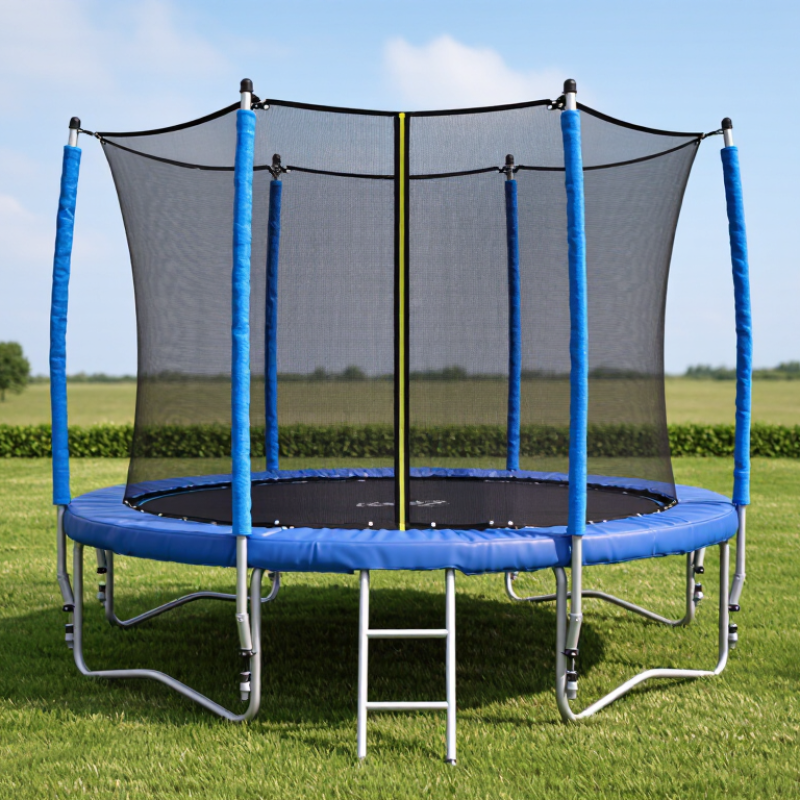
Round backyard trampolines usually pair a circular jumping mat with steel springs, a frame, and an enclosure net. Their shape supports an even bounce, but frame diameter and weight rating still determine how many people the unit is designed to hold. One jumper at a time is the safer operating assumption. Check that the net closes securely and the padding covers the springs; small gaps can matter.
Springless models use flexible rods or other elastic systems instead of exposed springs. They can reduce contact with spring pinch points, though construction and maintenance still matter. In-ground round trampolines sit closer to lawn level, but need suitable drainage and airflow beneath the mat. Compact rebounders suit low-impact exercise, not the same jumping patterns as full-size backyard models. Not every yard works.
Feature checks should include corrosion-resistant frame finishes, clear assembly instructions, replaceable mats and nets, and a stated user-weight limit. ASTM International’s F381 consumer-trampoline safety specification addresses components, assembly, use, and labeling. The U.S. Consumer Product Safety Commission’s 2014 NEISS-based report estimated 104,691 trampoline-related emergency-department injuries that year. That historical figure is not a current annual count, but it reinforces why enclosure design and clear use limits deserve close attention. A low price can hide difficult upkeep.
Global buyers should assess a round trampoline manufacturer through verifiable production evidence, not polished catalogues. Ask for material specifications, weld and stitching inspection records, load-test methods, and batch traceability. Ask for evidence. A sample inspection should include frame joints, spring hooks, net seams, and packaging labels. These details help reveal whether quality checks cover real production or only a showroom sample.
The ISO Survey 2022 recorded 1,265,216 valid ISO 9001 certificates worldwide. That scale makes certification useful context, but it does not prove that each trampoline model has been tested or that every shipment meets specification. Request the certificate’s scope and expiry date, then compare it with the factory and product named in your order. Check testing against relevant requirements, such as ASTM F381, while confirming which standards apply in your destination market.
Delivery capability deserves equal scrutiny. The World Bank’s 2023 Logistics Performance Index covered 139 economies, underscoring how logistics conditions vary across markets. Ask suppliers for recent, redacted shipment records and written lead-time assumptions. Clarify carton dimensions, spare-part availability, and responsibility for damaged goods. A neat audit file can still miss inconsistent production; repeat inspections are less convenient, but often more revealing. Teams sometimes overlook this until a container arrives late or parts do not fit.
Production capability is more than a large factory floor. Reliable round-trampoline manufacturers should control steel-tube forming, welding, frame finishing, mat sewing, and final assembly. Ask for monthly capacity by model, not a single headline figure. Grand View Research estimated the global trampoline market at about USD 3.2 billion in 2023, with projected growth through 2030. That demand makes repeatable quality important. Still, market growth does not prove a supplier can meet your schedule.
Check how the factory handles the details. Look for documented incoming-material checks, weld inspections, stitching checks, and finished-product load testing. Ask how test results connect to each production batch. A useful factory visit follows one frame from cut steel to packed carton. You may find a capable supplier with limited seasonal capacity; that is easy to overlook. Production claims deserve evidence.
Tips: Request a sample test report, a dated production plan, and photos of the actual line. Confirm whether testing covers frame strength, mat attachment, and repeated-use fatigue. Compare those records with the model you plan to order. Small gaps matter. A neat sample does not always represent a full production run.
For global buyers, quality begins with the frame, springs, mat, and enclosure—not just a supplier’s certificate. ASTM F381 and EN 71-14 set safety benchmarks for consumer and domestic trampolines in different markets. Ask which standard applies to the exact model and destination. A certificate for a similar product is not enough. Small details count.
UNCTAD’s Review of Maritime Transport 2024 reports that maritime trade volume grew 2.4% in 2023. Since more than 80% of world merchandise trade by volume moves by sea, shipping preparation affects delivery as well as cost. Request carton dimensions, gross weight, packing photos, and the planned loading method. Confirm that the frame and springs are protected from moisture and abrasion. Check that labels and manuals match the destination market’s language and requirements.
Before shipment, review the test report’s model number against the purchase order. Then check the packing list and shipping documents for consistent quantities and descriptions. A container may arrive intact while one box is missing. Paperwork can look perfect, too. I would still verify samples and records independently; supplier documents help, but they do not replace careful inspection.
| Evaluation Area | What Buyers Should Check | Relevant Standard or Requirement | Useful Evidence to Request |
|---|---|---|---|
| Product safety | Confirm that the complete trampoline—including frame, springs or elastic system, jumping mat, enclosure, padding, and access points—has been assessed as an assembled product. | EN 71-14 covers domestic trampolines in the European toy-safety standards series. ASTM F381 covers safety specifications for trampoline components, assembly, and use. | Test reports identifying the exact model, configuration, test method, sample, and report date. Check that accessories and product revisions match the tested version. |
| Market-specific compliance | Identify the destination country and intended user before confirming applicable rules. Requirements can differ by market and by whether the product is classified as a toy or sporting equipment. | For products within scope, EU toy requirements may involve the Toy Safety Directive and applicable harmonised standards. The EU General Product Safety Regulation has applied since 13 December 2024 to consumer products within its scope. | A written compliance matrix for each destination, including product classification, applicable legislation, required warnings, traceability details, and the responsible economic operator where required. |
| Chemical and material controls | Check coatings, plastics, foam, textiles, and other accessible materials for restrictions relevant to the destination market. | EU REACH restrictions apply to substances and articles within their scope. In the United States, CPSIA requirements may apply to products intended primarily for children, including applicable lead and phthalate limits. | Material declarations and risk-based laboratory reports tied to the supplied materials and product version. Verify whether children’s-product testing or certification obligations apply. |
| Load and configuration | Compare the stated maximum user weight, intended user count, trampoline diameter, enclosure arrangement, and installation conditions across the product, packaging, and manual. | There is no single maximum user-weight value that applies to all round trampolines. The rating must be specific to the design and supported by appropriate assessment or testing. | Model-specific load-rating rationale, test documentation, dimensional drawings, bill of materials, and confirmation that the manual and product labels show consistent limits. |
| Durability and construction | Review frame geometry, welds and joints, corrosion protection, spring or elastic-system attachment, mat stitching, and enclosure-net connections. | Durability and safety checks should follow the applicable product standard and test plan; performance results should not be assumed to transfer automatically between different models. | Inspection criteria, sample test records, material specifications, production change-control procedures, and corrective-action records for nonconforming batches. |
| Quality management | Assess whether the production site can maintain consistent materials, assembly processes, inspections, and traceability. | ISO 9001:2015 is a quality-management-system standard. Certification to it is not, by itself, proof that a particular trampoline meets product-safety requirements. | Current certificate with site and scope details, incoming and in-process inspection records, final-inspection criteria, lot coding, and a process for managing design or supplier changes. |
| Labels and instructions | Check that warnings, assembly instructions, maintenance guidance, and safe-use information are legible and provided in languages required for the destination market. | Required wording and language depend on the applicable market rules and product standard. Instructions should match the actual model and included components. | Final artwork, instruction manual, label-location drawings, packaging proofs, and confirmation of market-specific language and traceability information. |
| Packaging and freight readiness | Confirm carton dimensions, gross and net weight, protection of frame and jumping components, package count, and suitability for the agreed transport mode. | Freight costs depend on shipment size, weight, route, service, and carrier rules. No universal shipping cost or transit time applies to all orders. | Final carton specification, packing list, pallet plan if applicable, loading photos, and a shipment quotation stating origin, destination, transport mode, and included services. |
| Trade terms and customs | Agree who arranges carriage, export and import formalities, insurance, and delivery responsibilities before placing the order. | Incoterms® 2020 defines commonly used delivery terms and the allocation of specified costs and risks. The correct customs classification should be confirmed for the product and importing country. | Purchase contract naming the precise Incoterms rule and place, commercial invoice, packing list, origin documentation where applicable, and broker-confirmed tariff classification. |
| Supplier comparison | Compare suppliers using the same product specification, destination market, testing scope, order quantity, and delivery basis. | Certificates and test reports are meaningful only when their scope, issuing body, model identification, and validity can be checked. | A side-by-side quotation, sample approval record, compliance document index, production schedule, warranty terms, spare-parts plan, and written quality agreement. |
Buyer note: The standards and regulations listed are examples of requirements that may be relevant; applicability depends on product classification, design, intended users, and destination market. Confirm current requirements with qualified testing, compliance, and customs professionals before shipment.