


Top 10 Stainless Steel Syringes for Global Buyers

Choosing the right Stainless Steel Syringes requires more than comparing prices or polished product photos. Global buyers must examine material grade, construction quality, capacity, connection type, and intended application. A syringe used for laboratory sampling may need different features from one used in veterinary, industrial, or research environments. Small details matter. A smooth plunger, readable graduations, and a secure tip can influence daily accuracy.

This guide introduces ten Stainless Steel Syringes selected for practical comparison. Each option is considered through durability, cleanability, corrosion resistance, supplier transparency, and documented quality controls. Buyers should also review sterilization instructions, packaging conditions, batch traceability, and applicable regional standards before placing an order. Certifications can support confidence, but they do not replace independent verification or careful product inspection.

Real purchasing experience often reveals gaps between specifications and actual performance. A syringe may look excellent online but feel stiff during repeated use. Another may offer strong construction yet provide limited support after delivery. These imperfections deserve attention. No single model suits every buyer.

The ranking is therefore a practical starting point, not an absolute verdict. Product availability, shipping rules, import requirements, and authorized-use policies can vary across countries. Reliable suppliers should provide clear technical documents, responsive communication, and consistent quality evidence. Buyers should request samples when possible and confirm compatibility with their equipment before committing to larger quantities. This approach supports safer decisions, more predictable operations, and better long-term value.
Top 10 Stainless Steel Syringes for Global Buyers

Stainless Steel Syringe Fundamentals: 316L Chemistry Under ASTM F899

For global buyers, stainless steel syringe selection starts with chemistry, not appearance. ASTM F899 identifies 316L as a surgical-instrument stainless steel with balanced corrosion resistance. Its composition includes 16–18% chromium, 10–14% nickel, and 2–3% molybdenum. Carbon remains limited to 0.030% maximum, helping reduce sensitization after welding or heat exposure. Iron forms the balance.

This chemistry matters at the barrel, tip, and welded joints. Molybdenum improves resistance to chloride attack, while chromium supports the passive oxide layer. Yet 316L is not automatically corrosion-proof. Residual polishing compounds, saline deposits, and poor rinsing can create visible staining. ASTM F899 defines material chemistry, but it does not replace dimensional checks, cleaning validation, or functional testing. That distinction is easy to miss.

The International Stainless Steel Forum reported approximately 58.4 million tonnes of stainless crude steel production in 2023. This scale supports broad material availability, but supply volume does not guarantee medical-grade consistency. Buyers should request heat numbers, certificates, surface-finish records, and traceable test results.

Tips: Check the certificate against ASTM F899 limits, especially carbon and molybdenum. Inspect the inner barrel under magnification. A smooth surface should show no pits, burrs, or trapped residue. Test repeated plunger movement with the intended fluid. This practical step often reveals problems that chemistry alone cannot predict. Some assumptions still need challenging.

How ISO 7886-1 Defines Syringe Performance for Global Buyers

When global buyers compare stainless steel syringes, ISO 7886-1 offers a practical performance framework. It covers manually operated, sterile, single-use hypodermic syringes. The standard does not make every syringe suitable for every procedure.

In procurement work, I examine more than steel grade or surface finish. ISO 7886-1 addresses functional performance, including leakage, air leakage, piston movement, dead space, and scale readability. These details matter during filling and delivery. A barrel may look precise, yet a stiff piston can disturb controlled dosing. Small residual volume can also affect expensive solutions.

The standard provides test methods and acceptance requirements for key syringe characteristics. Buyers should request test records linked to the exact model and size. Check the nominal capacity, graduation interval, nozzle design, piston fit, and packaging condition. Inspect samples under normal lighting. Blurred graduations are easy to miss in a catalogue image.

Stainless steel can improve durability in certain specialist designs, but ISO 7886-1 does not automatically confirm corrosion resistance, compatibility, or clinical suitability. Those questions need separate evidence. Ask for material specifications, sterilization validation, and shelf-life data. Verify whether the product is single-use and sterile as supplied.

One caution remains. Standards support comparison, not blind approval. National requirements may add further obligations. Confirm the current standard edition and local market rules before purchasing. A supplier’s certificate is useful, but independent or accredited testing is stronger evidence. Weak documentation should slow the decision.

Top 10 Stainless Steel Syringes for Global Buyers - How ISO 7886-1 Defines Syringe Performance for Global Buyers
A practical comparison of representative stainless steel syringe configurations for laboratory, sampling, dispensing, and industrial applications.
Rank Representative Syringe Configuration Nominal Capacity Typical Graduation Common Tip or Connection Typical Needle Compatibility Indicative Dead-Space Target Recommended Application ISO 7886-1 Performance Checkpoint Global Buyer Consideration
1 Fine-volume stainless steel syringe with fixed blunt tip 0.5 mL 0.01 mL Fixed blunt metal tip 27–33 gauge, application dependent ≤ 0.01 mL Micro-dispensing, analytical preparation, and precise liquid transfer Graduation legibility, delivery accuracy, leakage resistance, and smooth plunger movement Confirm calibration method and compatibility with low-volume dosing equipment
2 Small-volume stainless steel syringe with Luer-lock outlet 1 mL 0.01 mL Luer-lock connection 25–30 gauge ≤ 0.02 mL Laboratory dosing, sample preparation, and controlled injection Dimensional conformity, plunger seal integrity, leakage under pressure, and readable scale markings Check Luer-lock dimensional compatibility with needles and adapters used in the destination market
3 General-purpose stainless steel syringe with replaceable needle 2.5 mL 0.1 mL Luer-lock or threaded metal tip 20–27 gauge ≤ 0.04 mL Routine laboratory transfer, reagent dispensing, and sampling Graduation accuracy, barrel dimensional stability, air leakage, and operating force Request material declarations for wetted parts and verify resistance to the intended chemicals
4 Medium-volume stainless steel syringe for viscous liquids 5 mL 0.2 mL Luer-lock connection 16–23 gauge ≤ 0.08 mL Oil, solvent, coating, and moderately viscous liquid dispensing Plunger force, leakage at the barrel and tip, delivery volume, and scale readability Evaluate plunger load at the actual liquid viscosity and operating temperature
5 Robust stainless steel syringe with reinforced plunger assembly 10 mL 0.5 mL Luer-lock or threaded metal outlet 14–21 gauge ≤ 0.15 mL Industrial sampling, laboratory dosing, and repeated non-sterile use Barrel strength, leakage resistance, plunger movement, dimensional accuracy, and marking permanence Confirm whether the design is intended for reusable service or sterile single-use supply
6 Large-volume stainless steel syringe for controlled transfer 20 mL 1 mL Luer-lock, threaded, or hose-adapter outlet 12–18 gauge ≤ 0.30 mL Bulk liquid transfer, equipment charging, and process sampling Leak testing, delivery-volume accuracy, plunger force, and resistance to deformation Check connection geometry, pressure limits, and cleaning validation requirements
7 High-capacity stainless steel syringe with metal outlet 30 mL 1 mL Threaded metal tip or Luer-lock adapter 10–16 gauge ≤ 0.45 mL Industrial dispensing, fluid sampling, and controlled equipment filling Barrel dimensional consistency, leakage under specified pressure, delivery accuracy, and operating force Confirm the allowable pressure and whether the syringe is suitable for hazardous liquids
8 Large-volume stainless steel syringe with replaceable accessories 50 mL 1 mL Threaded metal outlet or hose barb adapter 8–14 gauge ≤ 0.75 mL Process sampling, fluid transfer, and low-frequency bulk dispensing Leakage, scale legibility, dimensional performance, plunger travel, and mechanical durability Ask for cleaning, sterilization, and accessory interchangeability data before purchase
9 Extra-large stainless steel syringe for non-sterile process work 100 mL 2 mL Threaded metal outlet or process fitting 6–12 gauge, application dependent ≤ 1.5 mL Bulk sampling, laboratory process development, and equipment charging Leak resistance, delivery-volume consistency, plunger force, and dimensional stability Verify operator force, mounting requirements, and compatibility with the process fluid
10 Very-high-capacity stainless steel syringe for specialized transfer 250 mL 5 mL Threaded metal outlet or custom process connection Application-specific outlet; generally not supplied with a standard hypodermic needle ≤ 3.5 mL Specialized industrial transfer, sampling, and laboratory-scale process operations Leakage, delivery accuracy, structural integrity, plunger force, and connection performance Use a project-specific specification for pressure, cleaning, sterilization, and connection standards
Standards note: ISO 7886-1 specifies requirements and test methods for sterile single-use syringes intended for manual use. Stainless steel syringes designed for reusable or industrial applications may not fall within the standard’s scope; buyers should request a documented conformity assessment for the exact product configuration. The graduation, leakage, dimensional, delivery-volume, and plunger-force items above are practical evaluation checkpoints rather than claims of certification.

The Top 10 Stainless Steel Syringes Ranked by Capacity, Gauge, and Accuracy

Top 10 Stainless Steel Syringes for Global Buyers

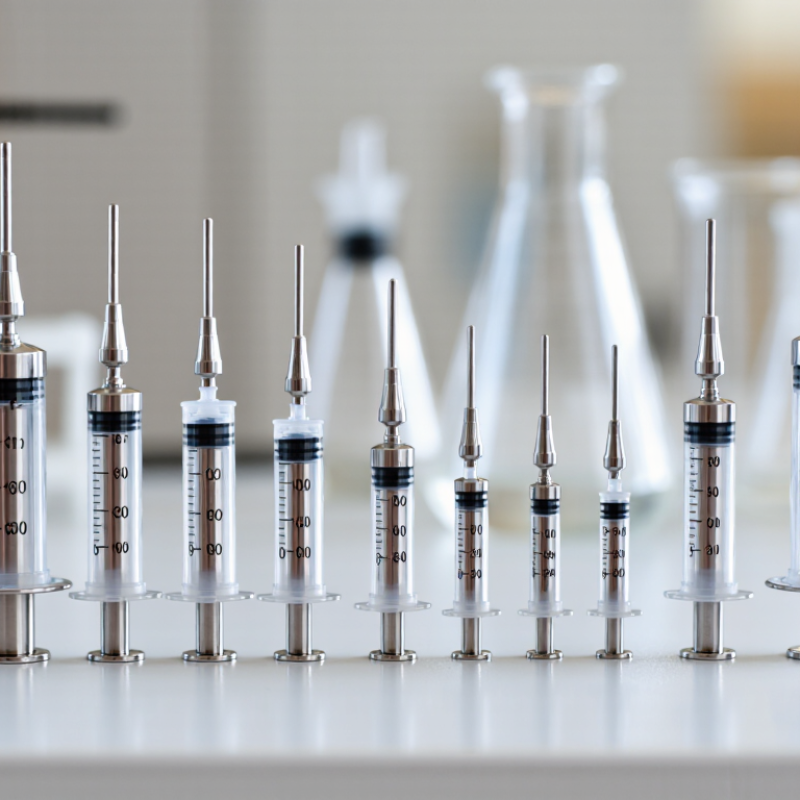
The top ten stainless steel syringe configurations depend on capacity, gauge, and measured accuracy. A 1 mL syringe with a 30G needle ranks highly for precise, low-volume laboratory work. A 1 mL, 27G model offers slightly faster delivery with good control. The 3 mL, 25G option suits routine sampling and controlled dispensing. A 3 mL, 21G syringe handles thicker fluids more efficiently. The 5 mL, 23G design balances capacity and precision for general applications. A 5 mL, 18G version supports faster transfer but may reduce fine control. The 10 mL, 21G syringe fits medium-volume tasks. A 10 mL, 18G model works better with higher flow demands. The 20 mL, 16G syringe provides greater capacity for bulk handling. The 50 mL, 14G configuration ranks last for precision, but leads for volume.

Accuracy depends on more than syringe size. Check plunger fit, barrel markings, dead space, and stated tolerance. Request calibration records and material certificates from the supplier. Stainless steel grade also matters in humid or chemical environments. Confirm sterilization compatibility before purchase. Small errors become expensive at scale. I would not rank a large syringe highly for delicate dosing, even when its construction feels stronger.

Tips: Match the gauge to fluid viscosity, not habit. Compare graduation spacing carefully. Ask for sample testing before a large order. Review regional documentation requirements, because import standards differ. A polished barrel looks reliable, but appearance cannot replace measured performance.

Sterilization, Pressure, and Biocompatibility: ISO 9626 Buyer Benchmarks

Top 10 Stainless Steel Syringes for Global Buyers

Sterilization, Pressure, and Biocompatibility: ISO 9626 Buyer Benchmarks

Choosing stainless steel syringes requires more than checking a polished barrel. ISO 9626 mainly addresses stainless steel needle tubing, including dimensions, strength, and surface quality. It does not approve a complete syringe. Buyers should request material certificates, dimensional reports, and lot traceability for every shipment.

Sterilization performance needs separate evidence. Ask whether the syringe tolerates the planned cycle, such as steam, dry heat, or validated chemical processing. Repeated exposure can affect seals, fittings, and surface finish. A supplier should provide cycle data, packaging details, and sterility validation when sterile delivery is required. Do not accept “sterile” as enough proof.

Pressure testing must match real use. A syringe for controlled laboratory transfer may need different limits than one used with viscous fluids. Check burst pressure, leakage results, connection security, and test methods. Biocompatibility also deserves careful review. Stainless steel composition, lubricants, adhesives, and residues can influence patient-contact safety. Request relevant ISO 10993 evaluations and extractables data when applicable. Surface smoothness matters, but it cannot replace biological assessment.

Small details matter.

From practical purchasing experience, certificates sometimes describe the tubing, while the assembled syringe remains undocumented. That gap is easy to miss. ISO 9626 is a useful benchmark, not a complete quality claim. Recheck every specification against the final design, sterilization route, and intended contact duration.

Global Compliance Checklist: FDA 21 CFR, CE Marking, and ISO 13485 Suppliers

For the top 10 stainless steel syringes, compliance should guide selection, not appearance.

MedTech Europe’s 2024 facts report values Europe’s medical technology market at approximately €170 billion. That scale increases scrutiny across global supply chains. Under the EU Medical Device Regulation, verify classification, technical documentation, risk management, and the Declaration of Conformity. CE marking alone is not a universal quality certificate. Ask whether a notified body assessed the applicable conformity route.

For United States sales, review FDA 21 CFR requirements for quality systems, labeling, complaint handling, and device records. The FDA’s Quality Management System Regulation becomes effective in February 2026 and incorporates ISO 13485:2016. Request the supplier’s current certificate, audit status, and exact scope. ISO Survey 2023 reported more than 30,000 ISO 13485 certificates worldwide, but certification does not guarantee identical production discipline. That distinction matters.

Inspect traceability from steel heat number to finished syringe. Confirm material grade, dimensional tolerances, cleaning validation, packaging integrity, and sterilization evidence where applicable. ISO 10993 biocompatibility records may also support patient-contact evaluations. Ask for recent batch records, not only polished certificates.

I have seen supplier files with perfect paperwork and weak change-control details. That assumption deserves challenge. A practical checklist should include calibration records, nonconformance procedures, supplier controls, and transparent recall communication. Some documents may be unavailable for legitimate confidentiality reasons, but unexplained gaps should slow purchasing decisions.