



What Are the Top Storage Tray Types in 2026?

Storage trays may look simple, but the right design can make a crowded drawer, kitchen counter, or workbench easier to use. In 2026, useful options range from divided drawer organizers and stackable pantry trays to serving trays, desk caddies, and rugged workshop models. Each type solves a different problem. A shallow tray keeps keys visible by the door; a deep, non-slip tray can hold bottles without letting them slide. Small details matter.

This guide compares storage trays by their intended use, material, size, and ease of cleaning. Plastic can be lightweight and practical, while bamboo or wood may suit visible areas; metal trays often handle tougher daily use. These are trade-offs, not guarantees. A beautiful organizer may waste space if its compartments do not fit your belongings. Measure the shelf or drawer, check the usable interior dimensions, and consider whether trays need to stack or move often. Small checks help.

There is no single best tray for every home or workplace. Product descriptions can also make capacity sound clearer than it is, so verify dimensions before buying. The following overview highlights leading tray types and the situations where each tends to work well, while noting limitations worth considering. A little trial and error is normal.
What Are the Top Storage Tray Types in 2026?

What Is a Storage Tray and How Is It Used?

A storage tray is a shallow container that keeps small items grouped, visible, and easy to move. At home, it can hold keys beside the door or sachets in a kitchen drawer. In workshops and warehouses, trays help separate fasteners, components, and picking orders. Common types include open stackable trays, divided organizers, nesting trays, and compartmented parts trays. Choose one by checking the item size, load, access frequency, and cleaning needs. A tray that is too deep can hide small parts; one that is too shallow may spill them during handling.

Storage trays also support organized workflows, but they do not guarantee better efficiency on their own. MHI’s 2024 Annual Industry Report found that 55% of surveyed supply-chain professionals planned to increase investment in technology and innovation. Deloitte’s 2024 manufacturing outlook reported that 86% of surveyed manufacturing executives saw smart factory solutions as a likely source of future competitiveness. These findings concern broader operations, not trays specifically; still, clearly labeled trays can make items easier to locate within more connected workplaces. That is the point. A tray can also become a junk drawer if users skip labeling or return items to the wrong compartment. A practical test is simple: place a few frequently used objects inside, move the tray as you normally would, and see whether anything shifts or becomes hard to reach.

Which Materials Are Common in Storage Trays?

Storage trays commonly use polypropylene, polyethylene, PET, steel, aluminum, wood, or molded fiber. Plastic is light, washable, and easy to shape into divided compartments. Polypropylene handles routine moisture well; clear PET makes contents easy to see. Check heat and cleaning limits, though: resin type alone does not guarantee performance. Metal supports heavier loads but may dent or corrode if its coating is scratched. Wood feels sturdy, yet prolonged dampness can cause swelling. Molded fiber is light and often better suited to dry storage. Small details matter.

Material choice also has a wider waste context. The OECD’s Global Plastics Outlook reports that packaging accounted for about 40 percent of the 353 million tonnes of plastic waste generated worldwide in 2019 (OECD, 2022). The U.S. EPA reported 82.2 million tons of packaging and containers in the U.S. municipal waste stream in 2018; 53.9 percent was recycled (EPA, 2020). These figures cover packaging broadly, not trays alone. That distinction matters. A reusable tray can reduce disposable use when it lasts and fits the task. A tray that cracks quickly may not be the better choice. I’d treat recyclability labels as a starting point, since local sorting rules and mixed-material parts can affect the outcome.

Storage Trays in 2026: Common Types and Materials

Stackable trays, nesting trays, compartment trays, drawer organizers, and small-parts bins are common storage formats. The chart compares typical material density—not market share—using approximate values that vary by grade.

Lower-density plastics such as polypropylene and HDPE are lightweight options; ABS and PET are denser plastics, while stainless steel is substantially denser.

What Are the Leading Storage Tray Types in 2026?

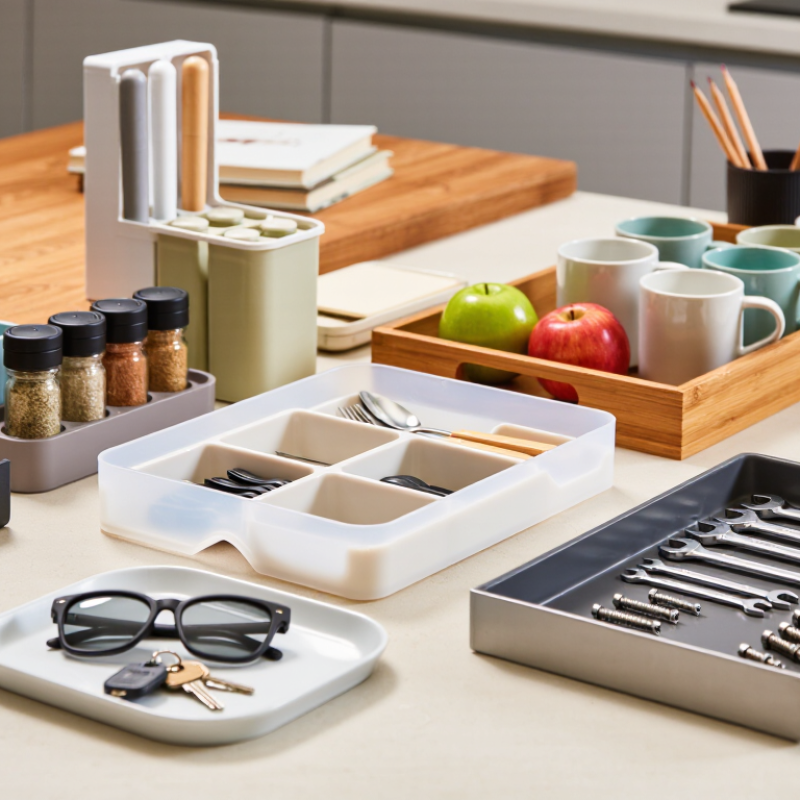
Leading storage tray types in 2026 are chosen for the items they hold, not just their appearance. Modular trays suit drawers that store changing mixtures of tools, stationery, or kitchen utensils. Their separate sections can be rearranged as needs shift. Stackable trays help use vertical space on shelves, though they need stable surfaces to prevent sliding.

Compartment trays remain useful for small items such as screws, craft supplies, or charging accessories. Look for dividers that fit the contents; oversized sections let pieces mix, while tiny ones waste space. Pull-out trays make deep cabinets easier to reach, especially when heavy cookware sits at the back. Smooth runners matter. A tray that jams when loaded becomes clutter with a handle.

Shallow utility trays work well on desks, counters, and inside frequently used drawers. They keep everyday objects visible and quick to grab. For damp areas, washable plastic or coated metal is often easier to maintain than untreated wood; material choice should match the setting. Measure the drawer’s interior, including its height and clearance, before buying. This step is easy to skip. I’d also leave a little room around irregular items, since tidy layouts rarely stay perfect for long.

How Do Storage Trays Serve Different Spaces and Tasks?

Storage trays work best when their shape matches the task. On a desk, a shallow tray keeps pens, clips, and charging cables visible without hiding them under papers. Small compartments help with tiny items, but too many can waste space. Leave room.

In kitchen drawers, adjustable dividers or low trays separate utensils and measuring spoons. Deeper utility trays suit cleaning supplies or craft tools that need more height. A non-slip base helps prevent items from sliding when drawers open quickly. For entryways, a sturdy catchall tray can hold keys and loose change, while a raised edge contains grit from damp shoes. Measure twice.

Stackable trays make use of vertical space in cupboards or work areas, though tall piles can become awkward to reach. Clear sides help identify stored items, while opaque trays can make a shelf look less cluttered. Match the tray material to its setting: wipeable surfaces are practical near sinks, and lightweight trays are easier to move between rooms. One limitation is easy to overlook: a tray can organize clutter without reducing it. Check what you actually use before assigning every item a compartment.

What Factors Help You Choose the Right Storage Tray?

Choosing a storage tray starts with what it must hold and where it will sit. Measure the shelf, drawer, or work surface before comparing options. A tray that is only slightly too wide can waste useful space. Check the item’s weight, too. Thin plastic may suit lightweight craft supplies, while reinforced plastic or metal can handle heavier tools. Material matters.

For kitchens or bathrooms, smooth, water-resistant surfaces are easier to wipe clean. Fabric trays work well for folded clothing, but they can collect dust and may sag under heavy items. Clear trays make small contents easier to spot; divided trays keep screws, clips, or jewelry from mixing. Handles help when moving a loaded tray, though they also take up room. A common mistake is choosing compartments that are too small. Measure the items, not just the available space. Your needs may change.

Tips: Before buying, place a few typical items together and note their dimensions. Check whether the tray stacks securely and whether its corners fit your shelf. If you are unsure, start with one tray rather than a full set. It is not always the neatest option, but it reveals what actually works.

What Are the Top Storage Tray Types in 2026? — What Factors Help You Choose the Right Storage Tray?
Category Tray Type or Factor Typical Characteristics Best Suited For Selection Notes
Tray type Plastic compartment tray Lightweight, easy to clean, and available with fixed or adjustable dividers. Small parts, craft supplies, hardware, and desk accessories. Check compartment dimensions and whether the plastic is suitable for the intended temperature and cleaning products.
Tray type Open utility tray Shallow, open-top design that keeps frequently used items visible and accessible. Entryways, workbenches, kitchen counters, and supply stations. Choose a rim height that helps contain items without making them difficult to retrieve.
Tray type Stackable or nesting tray Designed to stack securely when loaded or nest together when empty, depending on the model. Closets, storerooms, workshops, and other spaces where efficient use of space matters. Confirm that the trays are compatible with one another and fit the available shelf height.
Tray type Metal tray Often rigid and durable; finishes and corrosion resistance vary by material and coating. Tools, heavier supplies, and settings that need a sturdy tray. Review the stated load capacity, edge finish, and suitability for damp or corrosive environments.
Tray type Wooden tray Rigid construction with a natural appearance; surface protection and moisture resistance depend on the finish. Home organization, serving, display, and tabletop storage. Consider the finish, cleaning requirements, and exposure to moisture before choosing.
Tray type Silicone tray Flexible and non-rigid; some products are designed for food use or high-temperature applications. Kitchen drawers, small items, and applications specified by the product maker. Verify food-contact or temperature suitability from the product specifications rather than assuming it.
Tray type Fiberboard or cardboard tray Lightweight, often economical, and usually less resistant to moisture and heavy loads than rigid materials. Light-duty storage, packaging, sorting, and temporary organization. Check the tray’s strength and moisture protection for the expected duration and environment.
Key factors for choosing the right storage tray
Selection factor Stored items and dimensions Measure the items and the usable space, including shelf or drawer clearance. Any storage area with limited dimensions or items of varied sizes. Allow enough room to remove items easily; check internal dimensions as well as external dimensions.
Selection factor Weight and load capacity Tray capacity depends on its material, design, support, and how the load is distributed. Tools, hardware, supplies, or other heavier contents. Use the manufacturer’s stated capacity and consider the strength of the shelf or surface beneath it.
Selection factor Environment and cleaning Moisture, heat, chemicals, and cleaning methods can affect material performance. Kitchens, bathrooms, workshops, garages, and shared work areas. Select a material and finish rated for the actual conditions; follow its care instructions.
Selection factor Access and organization Open trays provide quick access; compartments separate items; covered designs help keep contents contained. Daily-use supplies, small components, and items that need sorting. Choose compartment size and tray depth based on how often items are accessed and how they are sorted.
Selection factor Portability and stability Handles, a stable base, and secure stacking features can make moving or storing trays easier. Items moved between rooms, work areas, or storage shelves. Check handle comfort, grip, and stack stability with the intended contents in place.